
Apollo Gives You 10,000 Leads. Here's How to Find the 40 Worth Contacting
A practical framework for ranking B2B prospects using ICP fit, intent, timing, and buying signals.

Apollo can give you 10,000 leads before your coffee gets cold.
That sounds useful.
It is also where the trouble starts.
Because 10,000 rows in a spreadsheet are not 10,000 opportunities. They are 10,000 maybes.
Some work at the wrong companies. Some have the right title but no reason to care about your offer. Some have a verified email and absolutely nothing else going for them.
Yet we call all of them leads, put them into a sequence, and act surprised when nobody replies.
The bottleneck is no longer finding people. It is deciding who deserves your attention.
That is the problem I kept running into while building HitUp. Getting names and email addresses was easy. Working out which companies were actually worth contacting, and why now might be a good time, was the real job.
So let us do that job properly.
The short answer
To find the 40 strongest prospects from a large Apollo search:
- Search Apollo using your ICP: industry, size, location, title, and any other hard requirement.
- Apply hard filters and remove every company that fails a non-negotiable requirement.
- What remains is your working pool, for example 10,000 matching contacts.
- Run an initial fit ranking so research time goes to the companies most likely to matter.
- Research the top-ranked companies for evidence of the problem and a reason the timing is right.
- Re-rank with that research. This final ranking weighs ICP fit, evidence, timing, intent, signals, and the decision-maker most likely to own the problem.
- Manually review the top of the list: check sources, roles, and contact data.
- Ship the final 40.
That is Apollo lead prioritization in plain English.
How the pool narrows down
Apollo search
Search by industry, size, location, title, and other ICP basics.
Hard filters
Remove every company that fails a non-negotiable requirement.
10,000 matching contacts
The working pool left once the hard filters are applied.
Initial fit ranking
A light pass to decide which companies earn a closer look.
Company research
Look for evidence of the problem and a reason the timing is right.
Final ranking
Re-rank with the research: fit, evidence, timing, intent, and signals.
Manual review
Check every source, role, and claim by hand.
40 companies
Researched, ranked, and ready to contact.
A qualified B2B prospect is a company that fits your ICP, shows relevant evidence or timing, and has a reachable person who likely owns the problem.
The order matters. If you start with email addresses, you will mistake contact data for sales relevance. They are not the same thing.
Apollo is a starting pool, not a sales strategy
Apollo is very good at finding possible matches.
You can filter people and companies by things like job title, location, company size, industry, technology, job postings, and buying intent. Apollo also offers signals and AI research. Its official guide lists the available people and company search filters.
This helps you turn a huge database into a smaller pool.
But a filtered record is still only a candidate.
Imagine two companies that both match your search:
- Both are B2B SaaS companies.
- Both have around 100 employees.
- Both are in the United States.
- Both have a VP of Sales with a verified email.
On paper, they look almost identical.
But one has been quiet for a year.
The other just hired a new sales leader, opened six sales roles, and entered a new market.
Same filters. Very different priority.
Apollo helped you find both. It did not make the final decision for you.
Start with reasons to say no
Most people begin an ICP by describing everyone who could possibly buy.
That is how an ICP slowly becomes "companies with money."
A useful Ideal Customer Profile should be strict enough that two people can look at the same company and reach roughly the same conclusion.
"B2B SaaS companies in the US" is not enough.
You may also need to define:
- Company size
- Product type
- Customer type
- Sales model
- Market
- Growth stage
- Relevant team size
- Technology
- Problem you solve
Then define the rejection list.
For example:
- Agencies
- B2C companies
- Companies below 20 employees
- Restricted industries
- Existing customers
- Companies your team already contacted
This part is not exciting. It is still one of the most important parts.
A strong buying signal cannot rescue a bad fit.
If the company cannot realistically use, afford, or benefit from your offer, remove it before doing expensive research.
The four questions that matter
1. Could this company become a good customer?
This is ICP fit.
Check the basics: industry, size, location, business model, customer type, sales motion, and any other hard requirement.
Be strict here.
Making the pool wider feels productive because the number goes up. In reality, you are often just creating more weak companies to research later.
2. Is there evidence of the problem you solve?
A company can fit your ICP and still have no visible need for your offer.
Look for evidence that connects directly to the problem you solve.
If you sell sales-onboarding software, useful clues could include:
- Several open SDR roles
- A fast-growing sales team
- A new sales leader
- Expansion into a new market
- Public comments about slow ramp-up time
"The company wants to grow" is not evidence. Almost every company says that.
The signal matters only when you can explain the connection:
This happened. It may create this problem. Our offer helps with that problem.
If you cannot complete that sentence without making things up, the signal is weak.
3. Why might now be a good time?
This is where timing, intent, and buying signals come in.
Useful changes can include:
- New funding
- A new executive
- Department growth
- Relevant job openings
- A product launch
- Market expansion
- A technology change
- A public statement about a priority or problem
None of these proves the company wants to buy.
Funding does not mean "please send me a cold email."
A new VP does not mean budget has already been approved.
Signals are clues. Their job is to give you a sensible, source-backed reason to start a conversation now instead of six months from now.
4. Who actually owns the problem?
Only choose the person after the company earns a place on the list.
Depending on what you sell, that person might be a founder, department head, director, VP, or operations leader.
Check three things:
- Do they still work there?
- Does their role connect to the problem?
- Can you reach them using usable contact information?
Apollo defines a verified email as a confirmed, valid address in its email status documentation.
That is valuable.
It still does not make the person a qualified prospect.
A verified email tells you the door probably works. It does not tell you whether you should knock.
Research the company once
Suppose Apollo returns five relevant titles at the same company.
You could research all five people separately.
You could also spend five times as much effort learning almost the same thing.
The cleaner approach is:
- Research the company.
- Decide whether the account deserves attention.
- Choose the strongest decision-maker inside it.
Add a second person only when there is a real reason, such as a separate business buyer and technical buyer.
This keeps your final 40 from becoming 12 companies repeated across different job titles.
Want this done for your ICP?
HitUp researches and ranks companies using ICP fit, intent, timing, and buying signals.
Start your prospect searchUse a score, but do not worship it
A scoring model helps you make consistent decisions.
Run it twice. A light initial fit ranking on raw search data decides which companies earn a closer look. A full final ranking, done after research, decides which of those make the 40.
It does not turn uncertain public information into scientific truth.
Here is a simple 100-point model, best used for that final, fully-researched ranking:
- ICP fit: 0 to 40 points
- Problem evidence: 0 to 20 points
- Timing, intent, and buying signals: 0 to 20 points
- Decision-maker relevance: 0 to 10 points
- Contact data quality: 0 to 10 points
Apply hard disqualifiers before scoring.
If you only sell in Europe, a perfect US company still gets rejected. The score should not be allowed to argue with reality.
Also, a score of 86 does not mean there is an 86 percent chance of a sale.
It means this company looks stronger than the lower-scoring alternatives based on the evidence you found.
That is all.
The score sorts the queue. It does not predict the future.
A simple example
Imagine you sell software that helps B2B SaaS companies onboard new salespeople.
Company A
- 120 employees
- Right market and business model
- Verified VP of Sales contact
- No visible sales hiring
- No recent leadership change
- No clear public discussion of onboarding
Company A fits the basic ICP.
That is about all we know.
Company B
- 90 employees
- Right market and business model
- Recently hired a new VP of Sales
- Six open sales roles
- Announced expansion into a new market
- New VP discussed improving ramp-up time in a public interview
Company B should rank higher.
No single signal proves it wants your software. But together, the signals tell a coherent story:
The sales team is growing. A new leader is in place. The company is expanding. Ramp-up time has been named as a priority.
Now you have a reason to start a relevant conversation.
You also have to stay honest.
Six open roles support the claim that the sales team is growing. They do not prove the company is shopping for sales-onboarding software.
If the source does not support the sentence, delete the sentence.
What should the final 40 include?
A prioritized B2B prospect list should save the salesperson from repeating the research.
For every company, include:
- The company and why it fits the ICP
- A relevant decision-maker and their current role
- Usable contact information
- The strongest timing, intent, or buying signals
- A source link beside every factual signal
- A short "why now" explanation
- A practical conversation angle
Then manually check the final list.
Make sure the company meets the agreed criteria. Confirm that the person still holds the role. Check the contact status. Open the source. Read the sentence again.
Yes, this takes more work than exporting a CSV.
That is the point.
The export gives you records. The review gives you something a sales team can trust.
Why 40 can beat 10,000
There is nothing magical about the number 40.
It is simply big enough to test an outbound angle across a real group of companies and small enough to research properly.
A focused first batch helps you learn:
- Which company types respond
- Which signals lead to useful conversations
- Which job titles engage
- Which parts of the ICP are too broad
- Which assumptions were wrong
Then you improve the next batch.
A list of 10,000 generic contacts often hides these lessons. Everyone stays busy. Messages go out. Dashboards move.
But nobody can clearly explain why those 10,000 people were chosen.
Activity goes up. Understanding stays flat.
That is not scale. It is noise with a bigger spreadsheet.
How HitUp handles the research
HitUp researches and ranks companies using ICP fit, timing, intent, and buying signals.
AI handles the parts machines are good at: narrowing a large pool, comparing companies, finding relevant information, and organizing the evidence.
Humans handle the part that still needs judgment: checking the match, reading the sources, removing weak claims, and deciding whether each company deserves a place in the final list.
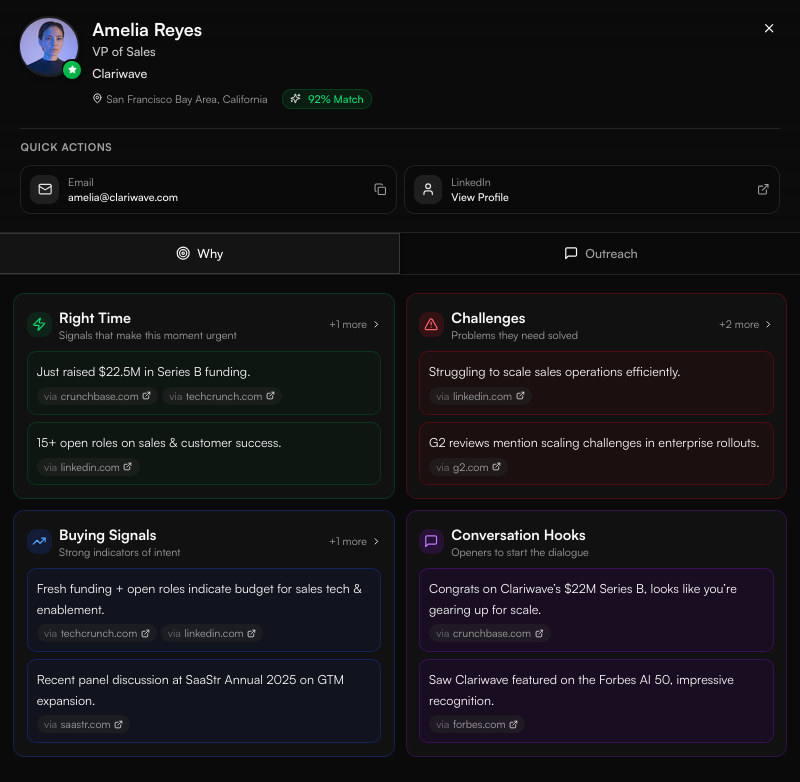
Each card in the final 40 looks like this: the match score, why the timing looks right, the challenges the company is likely facing, and a conversation hook backed by a clickable source, not a guess.
The pilot delivers 40 researched companies with relevant decision-maker contacts, source-backed buying signals, and a clear reason to reach out.
We do not promise replies, meetings, or sales. Nobody honest can promise those from a lead list.
We give your outbound team a better place to start.
If you want this process applied to your market, tell us what you sell and who you want to reach.
You probably don't need more leads. You need to know which ones matter.
HitUp researches and ranks companies using ICP fit, intent, timing, and buying signals, then manually reviews the final results.